
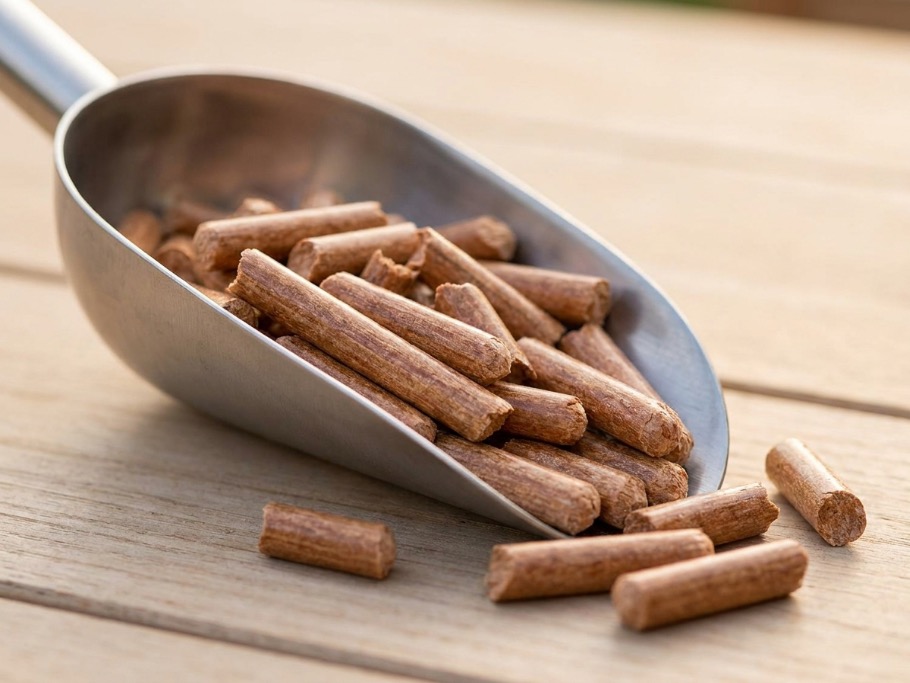
A bag labeled "hickory" pellets promises exactly that: hickory, and nothing else. That's the assumption almost every shelf shopper makes.
It usually isn't. Some of the most familiar pellet brands admit, in their own official FAQ pages, that a named-flavor blend runs on a cheaper base wood underneath the flavor, while a smaller set of specialist brands build their entire lineup around having none at all.
Neither approach is a scam. They're just not the same product, even when the bag names the same wood. Traeger's own product page for its Hickory pellets doesn't call them "100% hickory." It calls them "a premium, balanced blend of hardwoods." Bear Mountain's own FAQ names the base wood directly: alder or oak, "depending on the region of the country where the specific wood species are native."
On the September 14, 2026 stock check, all four picks were confirmed in stock at Amazon US. The four: LumberJack Competition Blend MHC, CookinPellets Perfect Mix, Bear Mountain Gourmet Blend, and Pit Boss Competition Blend. A stock snapshot is only good for the day it's taken, though. If you're reading this weeks later, check each pick's own affiliate link instead of this paragraph.
Why "100% Hardwood" Isn't the Claim You Think It Is
Read four brands' FAQ and product pages side by side, and you'll spot a labeling gap nobody names. "100% hardwood" and "100% of the named flavor wood" are two different claims. A bag can make the first one honestly while quietly not making the second.
Softwood is the low bar. Bear Mountain's own FAQ says never to cook with heating pellets that "may contain softwood," which produces "a harsh tasting soot when burned." Nearly every brand clears that bar easily. "100% hardwood" just confirms you're not burning heating pellets by mistake.
What it doesn't confirm is composition inside the hardwood category. Bear Mountain's own FAQ says its named-flavor blends run on "either Alder or Oak as a base wood," which it says "create a more consistent burn and smoking experience." Only its Oak and Alder pellets are "100% single species."
Two specialist brands take the opposite position. LumberJack's own pages state: "We don't use filler woods or artificially flavored oils... All of our grilling pellets are guaranteed to be pure virgin wood fiber." CookinPellets makes the identical claim for its Perfect Mix: "100% premium hardwoods," with no oak, alder, or softwood fillers. Both apply that promise across their whole named-flavor lineup, not just a single-species line.
Moisture, Not Brand, Is What Actually Ruins a Bag of Pellets
Pick any brand you're eyeing here. The pellet still has one real enemy: water. Traeger's own guidance is direct: "we do not recommend storing your pellets outdoors because moisture negatively affects the pellets, sometimes making them unusable." Its own support page adds the mechanism: moisture and humidity compromise pellet quality unless they're kept in a dry, airtight container.
We dug through owner forums for real-world evidence: real owners have hit this the hard way. On smokingmeatforums.com, one Rec Tec owner left pellets in a covered hopper in a humid garage for about a month. A bigger hopper is convenient, but it also means pellets sit longer, the flip side of the hopper-size question we cover in our sub-$500 pellet grill picks.
He came back to find "the pellets break down and jam the auger," a repair deep enough that removing the auger itself became its own problem. If that happens on a Traeger specifically, the exact fix depends on which controller your grill has.
On a different thread, a Pit Boss owner in a humid climate got this advice: "it is advisable to remove pellets from the hopper as they can absorb the moisture and swell causing feed problem." (Our Pit Boss 700FB2 vs. Traeger Pro 780 comparison covers that model's own hopper capacity in more depth.) A third member confirmed the same failure from the other direction. Pellets left outside uncovered "will probably log jam."
One habit protects your pellets no matter the brand: keep them airtight, indoors, off a damp floor.
Which Wood Suits Which Food, According to the Brands
If you're picking a bag by what you're cooking this weekend, know that the four brands here don't agree on how to frame that answer, and you won't find an independent ranking to settle it. Traeger's own page for its Hickory pellets calls the wood "great for naturally enhancing Beef, Chicken, Pork, and Veggies with full-bodied, bold flavor." Pit Boss makes a similar protein-specific claim for its Competition Blend: "a great choice for low and slow beef or pork," while also marketing the same bag as an all-purpose pellet that "pairs well with every dish."
Bear Mountain frames its Gourmet Blend around flavor rather than protein, describing the mix as smoky wood species combined with sweeter fruitwood species. LumberJack goes broadest of the four, calling its Competition Blend MHC "perfect for all foods." Treat every one of these as the brand's own marketing language, not a test result you can bank on.
Best Overall Blend: LumberJack Competition Blend MHC

LumberJack's Competition Blend MHC mixes maple, hickory, and cherry. The brand's own product page backs the no-filler claim the same way it does for every other pellet in its lineup: "guaranteed to be pure virgin wood fiber." That consistency across the whole catalog, not just one flagship bag, is why this is our starting point for most readers.
It's a genuinely balanced everyday blend. Hickory brings an assertive backbone, cherry adds mild sweetness, and maple rounds out the middle. That versatility is also its one real limit.
If you want a single dominant flavor rather than a balanced blend, this isn't that product. LumberJack's own 100% Hickory bag is the better fit, from the same brand, at the same no-filler standard.
A Rec Teq Pellet Grill Forum poster reports a first bag of the Competition Blend "worked good, smoked good, and tasted good," hedging with "I'm no expert" going in.
LumberJack Competition Blend MHC — What Works
- Maple, hickory, and cherry with no base wood or filler, per the brand's own product page
LumberJack Competition Blend MHC — Watch Out For
- A 3-wood blend, not a single dominant flavor, so no single wood note stands out on its own
Best for the Widest Flavor Spread: CookinPellets Perfect Mix

The same pattern shows up again here: CookinPellets takes the no-filler stance even further than LumberJack does. Perfect Mix combines four woods: hickory, cherry, hard maple, and apple. The product page states plainly: "100% premium hardwoods," with no oak, alder, or softwood fillers. CookinPellets also publishes a specific figure for this exact product: "high BTU (averaging 8500+) for a clean, hot burn." That number is tied to Perfect Mix specifically, not a category-wide claim.
The trade-off is the same shape as LumberJack's. Four woods in one bag means no single flavor dominates. If you want the boldest possible hickory or the mildest possible apple, a single-species bag beats any blend. Perfect Mix is built for breadth, not intensity.
A smokingmeatforums.com owner reports "not one complaint" across CookinPellets' 100% Hickory and Perfect Mix, singling out the Perfect Mix specifically as "hard to beat for day to day pellet cooking."
CookinPellets Perfect Mix — What Works
- Hickory, cherry, hard maple, and apple with no oak, alder, or softwood fillers, per the brand's own product page
- Published BTU figure (averaging 8500+) specific to this product, not a category-wide claim
- Four-wood spread gives more flavor range in one bag than a 3-wood blend
CookinPellets Perfect Mix — Watch Out For
- A 4-wood blend, not a single dominant flavor. A single-species bag from any brand beats it for maximum hickory or apple intensity specifically
Best if You Don't Mind a Disclosed Base Wood: Bear Mountain Gourmet Blend

Bear Mountain earns real credit here. Its own public FAQ tells you what's in a flavored bag before you buy it, which most brands don't do. Gourmet Blend is "a proprietary blend of robust smoky wood species combined with sweeter fruitwood species," built on the alder-or-oak base wood the brand discloses for its named-flavor lines generally.
That base wood isn't a hidden flaw. It's a stated design choice. Bear Mountain's own reasoning for it, "a more consistent burn and smoking experience," is a real trade-off, not marketing filler.
What you give up next to a specialist no-filler brand is the guarantee, not necessarily the cooking result. What you get is a brand stocked at more retailers than either specialist pick above.
A Rec Teq Pellet Grill Forum poster, after just one cook, reports the Gourmet Blend "seems good so far," with "plenty of good smoke at 225-250."
Bear Mountain Gourmet Blend — What Works
- Publicly discloses its base-wood practice in its own FAQ, rather than leaving buyers to guess
- A proprietary smoky-plus-fruitwood blend designed for balanced flavor and aroma
- Wide retail availability relative to the two specialist brands above
Bear Mountain Gourmet Blend — Watch Out For
- Built on an alder-or-oak base wood under the named flavor, per the brand's own FAQ. Not a filler-free pick if that guarantee matters to you
Best Budget Option: Pit Boss Competition Blend

Pit Boss's own product page checks the boxes that matter for a budget pick: "100% natural hardwood pellets," "no artificial flavors, spray scents, glues, or chemicals," and "little to no ash for easy clean up." It's a real, disclosed hardwood blend, not a mystery product.
What it doesn't disclose is which specific woods make up that blend, beyond "hardwood." That's a real, sourced-by-omission gap on Pit Boss's own listing. For a budget-minded, widely available default that still clears the hardwood-quality bar, it's a reasonable pick anyway.
A smokingmeatforums.com owner reports that the Competition Blend, bought cheap despite going in skeptical, delivered smokes that "have been good in my AMNPS."
Pit Boss Competition Blend — What Works
- 100% natural hardwood pellets with no artificial flavors, spray scents, glues, or chemicals, per the brand's own listing
- Markets little-to-no ash and low moisture content as explicit product features
- Widely stocked, budget-friendly default
Pit Boss Competition Blend — Watch Out For
- Doesn't name specific wood species beyond "hardwood blend" on its own product page. A real gap if you want to know exactly what you're burning
Pick By What Matters Most to You
- You want a guaranteed zero-filler blend at a fair price
- LumberJack Competition Blend MHC Check price →
- You want the widest flavor spread with zero base wood
- CookinPellets Perfect Mix Check price →
- You want wide retail availability and don't mind a disclosed base wood
- Bear Mountain Gourmet Blend Check price →
- You want the cheapest, most widely stocked option
- Pit Boss Competition Blend Check price →
One check applies no matter which of these four you land on, and to any brand not covered here: read that brand's own ingredients or FAQ page before you buy, not just its front-of-bag flavor name.
Our Verdict
If you're not sure where to start, the LumberJack Competition Blend MHC is simply the right call for you. It's a filler-free, balanced maple-hickory-cherry blend, backed by the same no-base-wood claim across the brand's whole catalog.
For more flavor range, the CookinPellets Perfect Mix's four-wood spread is worth the switch, backed by a published BTU figure.
The Bear Mountain Gourmet Blend suits a different priority: buying from a brand that tells you its base-wood practice upfront. That disclosed trade-off is a fair one, and it comes with wider shelf availability than the two specialists above.
Price and shelf availability matter most, and knowing the exact wood species matters least? The Pit Boss Competition Blend does the job.
None of these choices is wrong. The mistake is assuming the flavor name already told you which one you were buying.
Frequently Asked Questions
Does '100% hardwood' on a bag mean there's no filler wood?
Can I mix pellet flavors in the same hopper?
Why did my pellet grill's temperature drop mid-cook?
What Works
- Maple, hickory, and cherry with no base wood or filler, per the brand's own product page
Watch Out For
- A 3-wood blend, not a single dominant flavor, so no single wood note stands out on its own