
Pick a trusted brand, pick a size, done. That's the pitch behind nearly every "best pellet grill" roundup, and it skips the part that decides whether you'll be happy with the grill in six months.
A pellet grill is worth buying if your priority is hands-off temperature control across a wide range of techniques, from low-and-slow smoking through high-heat grilling, without babysitting a fire.
If your priority is being the best at one specific technique instead, a dedicated single-task tool wins. The fastest sear. The tightest low-and-slow profile. A dedicated tool beats even a well-reviewed pellet grill at that one job.
Decide breadth versus depth first. That answer, not brand reputation, should drive which spec on the sheet matters to you.
We looked at this differently than most roundups do. Nearly every pellet grill on the market is marketed as "6-in-1" or "8-in-1": grill, smoke, bake, roast, braise, sear. That claim is real and disclosed. A pellet grill genuinely can do all of those things in one chamber.
What the marketing doesn't say directly is that "can do" describes breadth of temperature range, not depth of performance at any single task. A dedicated gas grill still sears faster and hotter than most pellet grills' direct-flame add-on features. A dedicated offset smoker still holds a tighter, more traditional low-and-slow profile.
Every brand's own product pages sell you the range. None promise it beats a specialist at either end.
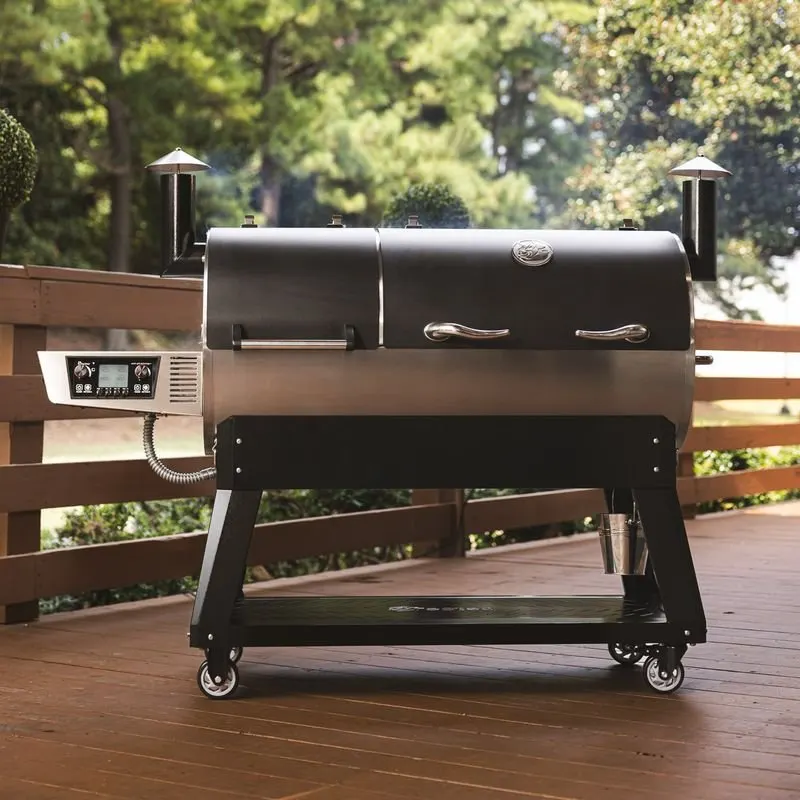
How a Pellet Grill Actually Works
A pellet grill burns compressed hardwood pellets fed automatically from a hopper, through an auger, into a fire pot. A hot rod ignites the pellets. A fan circulates the resulting heat and smoke through the cooking chamber by convection.

A controller, either an older thermostat-style cycle or a PID system, regulates auger feed rate and fan speed to hold whatever temperature you set. This is the mechanical difference between a pellet grill and a charcoal or offset design. Temperature holds automatically, rather than you managing airflow and fuel by hand.
The skill a new owner needs isn't fire management. It's trusting the controller. The most common early mistake is opening the lid to check food too often, which lets heat escape and forces the controller to spend fuel correcting a swing it didn't need.
Pellet grills are also a real but still-minority ownership category, one that grew fast in a short window. The Hearth, Patio & Barbecue Association's own biennial State of the Barbecue Industry Report found wood-pellet grill ownership roughly tripled among U.S. grill owners in the two years spanning the pandemic, from 3% to 9%.
That survey was fielded in September 2021 and reported that November, and remains the most recent pellet-specific figure HPBA has published. This is a category still gaining share, not a mature market where every brand has converged on identical hardware.
The Buying Decision, By Axis
"Which pellet grill is best" isn't one question. It's five, and different buyers weigh them differently.
Budget tier: what you give up
Entry pellet grills span the budget tier through sub-$500. The honest trade-off at that range is usually hopper capacity, not cooking performance.
Pit Boss's current entry FB2-series models, for instance, ship with a notably small hopper for their cooking area, meaning more refills on a long, unattended smoke. Our sub-$500 guide covers which models still deliver real cooking space at this tier. Move to sub-$1,000 and that sacrifice disappears; sub-$1,000 pellet grills add app control and tighter temperature accuracy without doubling the price.
Pit Boss vs Traeger, recteq vs Traeger, recteq vs Pit Boss, and Z Grills vs Pit Boss each name the cheaper option's trade-offs directly.
Smart and WiFi controllers: not every tier gets one
App control and WiFi connectivity aren't universal across a single brand's own lineup. They're usually reserved for a specific tier. Z Grills' entry-level Basic Series, for example, confirms no WiFi or app connectivity on its own product page. That's in contrast to the same brand's WiFi-branded flagship, sold in the same product collection.
Confirm model by model, not brand by brand. Z Grills vs Traeger covers the WiFi-tier trade-off. Z Grills Review covers a matching trap inside Z Grills' own catalog, a three-name WiFi flagship and a Basic Series with two similar siblings.
Temperature range and searing capability
This is where the breadth-versus-depth reframe above gets concrete. Some brands add a mechanical direct-flame feature specifically to close the searing gap. Pit Boss's FB2 series, for example, carries a "Flame Broiler" lever that opens direct flame access for searing, a feature Traeger's current lineup doesn't have at all.
Traeger's own current lineup, by contrast, caps out at 500°F across both its mid-tier and flagship lines. Neither approach is objectively better. They solve for different priorities. Traeger vs Weber Pellet Grill covers a matchup where one brand leans on warranty length and the other leans on searing capability, exactly the trade-off this axis is about.
That trade-off assumes a flat, horizontal barrel layout. Stack the racks vertically instead and the searing question disappears rather than shifts: every current vertical pellet smoker we've found tops out around 420°F with no direct-flame feature, in exchange for far more cooking capacity per square foot of patio.
Portability: a genuinely different product category
A portable pellet grill is a different chassis, not a shrunk-down full-size unit. Fold-down legs, a smaller hopper, and a travel footprint define the category, not size alone.
If tailgating or a small patio is the use case, comparing portable models against full-size ones on cooking area alone misses the point of either category. Best Portable Pellet Grill covers the picks that hold up specifically in that class.
Reliability: the real question isn't "which brand," it's "which controller"
Here's the pattern the roundups above skip entirely. The single most common pellet-grill failure, an auger jam, has one root cause across every brand. Wet or compromised pellets swell inside the auger shaft. Traeger's own support documentation states this plainly.
But the fix is not one universal procedure, and it doesn't split by brand the way most buying advice assumes. It splits by controller generation. Within Traeger's own current and recent lineup alone, there are four distinct fix paths, depending on whether a grill has a dial controller, a touchscreen controller, the newest Woodridge-generation controller, or an older AC motor with no WiFi at all. Traeger's own support library documents these as five separate, largely un-cross-referenced articles rather than one guide that routes a reader by generation.
Pit Boss's own guidance has the same shape from a different angle. The brand has never published one universal error-code list that applies identically across every control-board generation it has shipped. That's exactly why generic "Pit Boss error code" roundups elsewhere present a single flat list as though every unit runs the same board.
recteq's own pattern is different again: its Bullseye/Wi-Fi controller lineup carries exactly three error codes total, not a long flat list. But one of those three still bundles two genuinely different causes under a single code, which is its own version of the same underlying problem: a short list isn't automatically a clear one. Our recteq Error Codes guide covers which of the two causes is the more common branch.
The practical upshot: asking "is Brand X reliable" is close to unanswerable. The honest answer depends on which specific controller generation the unit in front of you has, and that can vary within one brand's current catalog, not just across brands. Traeger Auger Jammed and Pit Boss Error Codes both cover this in depth, organized by what your controller looks like, not by a flat list that assumes every unit is identical.
A separate failure mode gets confused with an auger jam constantly: smoke pouring out of the hopper lid itself, not the cooking chamber. That's fire traveling backward up the auger tube, not a moisture-swollen auger, and the fix is the opposite of cutting power. Smoke Coming Out of the Pit Boss Hopper covers Pit Boss's own one-step fix.
Where to Go From Here
Start from your own question, not a brand name; here's where we'd send you for each one:
- Not sure what size you need: our Grill Size Calculator matches your guest count and cook style to real, currently-available picks.
- Want a lower budget: sub-$500 pellet grills.
- A step up from entry-level: sub-$1,000 pellet grills.
- Pellet grill or offset smoker: Pellet Grill vs Offset Smoker.
- Pit Boss or Traeger at a similar cooking-space tier: Pit Boss vs Traeger.
- Which specific Pit Boss model to buy: Best Pit Boss Pellet Grill.
- Z Grills or Pit Boss at entry price: Z Grills vs Pit Boss.
- recteq or Traeger, and whether the price gap is worth it: recteq vs Traeger.
- A recteq that won't get hot enough, swings temperature, or runs uneven: recteq Not Heating Up.
- Wondering whether charcoal is the more "legitimate" choice, including for competition cooking: Pellet Grill vs. Charcoal Grill.
- Traeger's WiFi tier versus Z Grills: Z Grills vs Traeger.
- Traeger or Weber, and which trade-off matters more: Traeger vs Weber Pellet Grill.
- An electric smoker instead of a pellet grill at the same price point: Electric Smoker vs Pellet Smoker.
- Something that travels, tailgating, a small patio, a camper: Best Portable Pellet Grill.
- More cooking capacity per square foot of patio, at the cost of searing entirely: Best Vertical Pellet Grill.
- A jammed auger on a Traeger: Traeger Auger Jammed.
- A Pit Boss auger stuck: Pit Boss Auger Jam.
- A Pit Boss error code on the display: Pit Boss Error Codes.
- A Traeger that won't power on at all: Traeger Won't Turn On.
- A recteq showing ER-1, ER-2, or ER-3 on the display: recteq Error Codes.
- Same product labeled both "grill" and "smoker": Pellet Grill vs Pellet Smoker.
- Yoder or recteq, and whether real direct-flame searing beats cooking space: Yoder vs recteq.
Common Pitfalls Before You Buy
Storing pellets in the hopper between cooks. Pellets exposed to humidity absorb moisture, swell, and become the leading cause of the auger jams covered above. Keep bagged pellets in a sealed, airtight container instead of leaving a full hopper sitting between cooks. It's free, and it's the single habit that prevents the category's most common failure.
Assuming "8-in-1" means it performs best at all eight. That claim measures breadth, not depth, as covered above. If searing steaks is a weekly habit, weigh that against a dedicated gas grill rather than assuming a pellet grill's sear function matches it.
Treating electricity as optional. Every pellet grill depends on power for its auger, fan, and igniter. That holds across every current brand's own controller and construction documentation: Traeger's touchscreen and Smart Combustion system, Pit Boss's digital control board, Weber's Weber Connect display.
A power outage stops the cook outright, unlike a charcoal or gas grill. Weigh that if your area sees frequent outages. A grill that won't power on at all splits by controller generation the same way an auger jam does: see Traeger Won't Turn On for the fix.
Buying on hopper size alone, without checking cooking area. A bigger hopper means fewer refills, but says nothing about how much food fits on the grates. The two numbers vary independently, even within one brand's own lineup. Check both, or run your numbers through our Grill Size Calculator first.
Start With the Axis, Not the Brand
Confirm breadth versus depth first. That's what tells you whether a pellet grill is even the right cooker type for how you cook. After that, the axis that separates one model from the next is whichever trade-off you're least willing to accept.
Budget tier. Smart controls. Searing capability. Portability. How transparently a brand documents its own troubleshooting by controller generation. Not which name is on the hopper.
Reliability is the one axis with no brand-name shortcut. The real answer depends on your controller generation, which is exactly why the guides above are organized by generation and by matchup, not by a flat "best brand" ranking.