
Type "pellet grill vs. charcoal grill" into a search bar and you'll get the same framing every time: charcoal is the craft, pellet is the convenience. Tend a real fire and earn real barbecue, or push a button and let a controller do the work.
That framing has a rule working against it that none of those guides mention.
KCBS is the largest barbecue-competition sanctioning body in the US. It states its own contest heat-source rules directly on its own site. Wood pellets are a legal heat source, named right alongside wood and charcoal, for both its most popular contest format and its Backyard format. What that sanctioning body excludes by name is a gas or electric heat source, not wood pellets.
That's not a loophole. A pellet grill's actual heat still comes from burning wood pellets, the same combustion a fire needs whether you feed it by hand or by auger. The automation runs the fuel feed and the fan, not the flame.
That rule already draws the exact line the whole framing needed. It settles a "craft vs. convenience" argument that never needed to happen in the first place.
Our pellet grill guide covers the broader buying-decision axes across the whole category. This comparison zooms into one specific axis: pellet fuel vs. charcoal fuel, with two real, currently-sold grills.
We compared the Pit Boss 500FB2, an entry-tier pellet grill, against the Weber Original Kettle Premium 22". It's the reference charcoal kettle most buying guides use as their example. Here's what each fuel type actually buys you.

Why "Craft vs. Convenience" Isn't the Real Question
Every buying guide we checked walks through the same handful of traits: flavor, temperature control, searing, maintenance, cost. Every one ends in a pros-and-cons list, then a "it depends on your priorities" shrug.
None of them mentions competition rules at all, even though "which one is more legitimate/authentic" is the emotional core of how all three frame the debate.
None of them sources a real, lab-tested heat-ceiling figure either. Several buying guides state a charcoal heat ceiling well above what a stock kettle actually reaches, as a blanket category fact, with no test or model behind the number.
Consumer Reports' own lab test, run in an actual Weber kettle, measured something different. Lump charcoal ran 40-50°F hotter than briquettes under the same conditions. That's real and precise, far more modest than the unsourced blanket claim above. A number that big, if it's real anywhere, describes a thick-walled kamado, not a stock steel kettle.
And none of them puts two real, currently-sold grills next to each other with a genuine spec sheet. We wanted a real comparison, not another trait list. Here's what two real grills' own specs reveal.
Pit Boss 500FB2

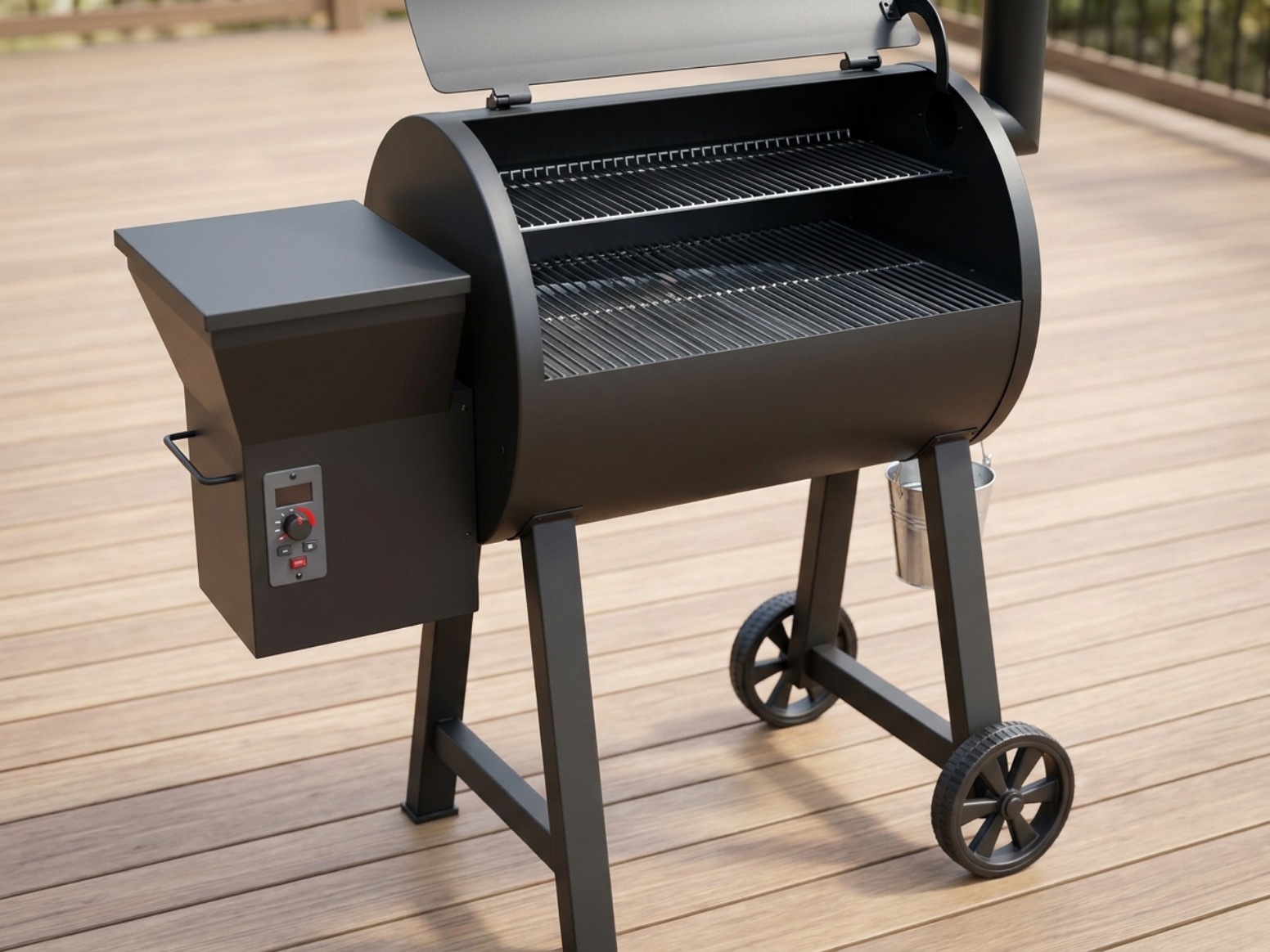
The 500FB2 is Pit Boss's entry-tier pellet grill, and its own product page states a 180°F to 500°F digital-controller range across 518 sq in of cooking space. A 5 lb hopper feeds an automated auger, so the controller holds a set temperature without you managing airflow by hand.
Here's the spec that complicates the "charcoal always sears hotter" assumption. Pit Boss's own product page rates the 500FB2's direct-flame Flame Broiler Lever, which exposes the cooking grate directly to the fire pot, at up to 1,000°F. That's Pit Boss's own manufacturer-stated maximum, not an independently tested figure.
It's still higher than either charcoal number in this comparison. The same grill that holds a set low, steady temperature can also open up for a real sear, though the 5 lb hopper below will need a refill partway through a longer overnight smoke.
The trade-off is hopper size. At 5 lb, the 500FB2's hopper is small relative to other current entry-tier pellet grills. That means more manual refills on a long, unattended smoke.
A Walmart buyer of this exact SKU reported, one day after getting the grill, that the build was heavy duty and the quality great, though the hopper size ran super small. That real-world account lines up with the spec above, not against it.
It's a real limitation, but it's the pellet-hopper-capacity trade-off every small pellet grill makes, not something specific to this model. If a bigger hopper matters more to you than this specific model, our sub-$500 pellet grill roundup covers several with more capacity.
Like every pellet-fed grill, the 500FB2 needs a power outlet. There's no battery or off-grid version of this specific model. If you're planning to cook at a campsite with no power, this isn't the tool for it.
Pit Boss 500FB2 — What Works
- 180°F-500°F digital controller range plus a direct-flame Flame Broiler Lever rated up to 1,000°F, covering smoking and searing on one grill
- 518 sq in of cooking space
- Backed by Pit Boss's 5-year warranty
Pit Boss 500FB2 — Watch Out For
- At 5 lb, a small hopper relative to other current entry-tier pellet grills, meaning more manual refills on a long smoke
Weber Original Kettle Premium 22"

Weber's Original Kettle Premium is the reference charcoal kettle most buying guides picture when they say "kettle grill." Its own product page states 363 sq in of cooking space. It also lists a porcelain-enameled bowl and lid, a built-in lid thermometer, and adjustable lid and bowl dampers for airflow control. Weber backs it with a 10-year limited warranty.
One verified Amazon buyer reports excellent heat control, a sturdy build, and even cooking every time on this exact model. That's a real-world account, not just the spec sheet, backing up the same durability claim.
There's no auger, no fan, no controller. Heat comes from how much charcoal you light and how far you open the dampers, full stop. That's the genuine advantage on the other side of the heat-source rule above. This grill needs zero electricity, so it runs anywhere, power outage or campsite included, with nothing to fail electronically.
Starting it from cold is a real, separate, manual step that a pellet grill's igniter rod skips entirely. Weber sells a dedicated tool, the Rapidfire Chimney Starter, whose own product page states it lights charcoal "quickly and evenly." A real product exists specifically to make that manual step easier. That fact alone is the evidence: lighting a kettle is genuinely hands-on, not a button press.
Once it's lit, there's no digital setpoint. You manage heat by damper position, thermometer, and experience for the whole cook. That's the real trade for the highest achievable heat and the lowest entry cost of the two. More skill is required, in exchange for direct control over the fire and a fuel choice (lump charcoal specifically) that lab testing above measured running 40-50°F hotter than briquettes.
Weber Original Kettle Premium 22" — What Works
- No electricity required at all, so it runs off-grid or through a power outage
- Porcelain-enameled bowl and lid with a 10-year limited warranty
- Lump charcoal measured 40-50°F hotter than briquettes in Consumer Reports' own lab test
Weber Original Kettle Premium 22" — Watch Out For
- Category-level charcoal-kettle limitation, not specific to this model: no automated temperature holding, the cook manages airflow manually for the entire session, and lighting from cold is a separate manual step with no push-button shortcut
What Actually Decides It
Skip the craft-vs-convenience framing. Here's the actual test.
Is a sanctioned BBQ competition genuinely on your list? If that's the real driver, it's not a reason to rule out a pellet grill. That sanctioning body's own rules already clear it, alongside wood and charcoal.
Cooking with no power outlet, off-grid, at a campsite, or through an outage decides it toward charcoal outright. The 500FB2 needs electricity for its auger, fan, and controller; the kettle needs none of that.
Wanting the highest achievable searing heat at the lowest entry cost, and being fine managing a fire by hand, also points toward the kettle, especially with lump charcoal specifically.
If none of those apply, the decision comes down to which failure mode you'd rather manage. Refill a 5 lb hopper more often on a long pellet smoke, or light and tend a fire manually for the whole cook. Neither is a dealbreaker.
They're just different amounts of hands-on attention attached to two different mechanisms. Already landed on pellet and just need to pick a brand? Our Pit Boss vs. Traeger comparison covers that decision separately.
If cooking area, not fuel type, is actually driving your decision, our Grill Size Calculator turns your typical guest count into a square-inch target you can match against either grill here.
Our Verdict
Both of these are genuinely solid at their price points. The honest choice depends on which failure mode and which constraint actually applies to how you cook, not on which fuel "sounds" more legitimate.
Pick the Pit Boss 500FB2 if you want hands-off temperature holding with real high-heat searing available when you want it, and a power outlet isn't a constraint.
Pick the Weber Original Kettle Premium 22" if you need to cook with no electricity at all, want the highest achievable heat with the right charcoal, or you're on the tightest entry budget between the two.
Either way, the number that should decide this isn't which one sounds more like "real" barbecue. It's whether you have a power outlet, whether you want to manage a fire by hand, and now, thanks to that sanctioning body's own rule book, one less bad reason to rule either one out.
Frequently Asked Questions
Does being competition-legal mean pellet grills win more often than charcoal?
Does charcoal really get hotter than a pellet grill?
Can a pellet grill run off-grid, like at a campsite?
What Works
- 180°F-500°F digital controller range plus a direct-flame Flame Broiler Lever rated by Pit Boss up to 1,000°F, covering low-and-slow smoking and high-heat searing on one grill
- 518 sq in of cooking space
- Backed by Pit Boss's 5-year warranty
Watch Out For
- At 5 lb, a small hopper relative to other current entry-tier pellet grills, meaning more manual refills during a long, unattended smoke