
Not every code on a Pit Boss's display is actually an error. Most troubleshooting lists treat all of them the same way, nine, thirteen, sometimes more Pit Boss error codes, each with a tidy cause and a tidy fix. None of those lists says where any of it comes from, or whether the code on your screen is even a real error.
Our pellet grill guide covers why this controller-generation pattern isn't unique to Pit Boss.
Pit Boss's own FAQ draws a distinction almost none of those lists make.
A code that flashes once at startup and clears on its own isn't an error at all. It's a harmless programming code, and the brand names several by number. Treating one of these as a real malfunction is the single most common false alarm we found in this research.
We checked the two top-ranked guides for this topic. Neither cites a source for a single code definition. Neither mentions that Pit Boss's own guidance is to check the owner's manual for your specific model, rather than trust one list across every control-board generation the brand has shipped.

Is It Actually an Error?
Start here before anything else. If a code appeared right when you plugged the grill in, then disappeared on its own within a few seconds, it's not an error.
Pit Boss's own FAQ names several of these harmless startup codes directly: L01, L02, 126, and 128 are programming codes, not malfunctions. They show briefly at startup and clear on their own while the grill is functioning normally.
A genuine error code is different. It persists on the display instead of clearing, and it usually stops the grill from heating or holding temperature.
ErL / Er1, the Temperature Probe Code
This is the code with the most independent owner corroboration we could find. Three separate threads on smokingmeatforums.com, spanning three different owners between 2019 and 2020, all point the same direction.
One owner's Pit Boss support call diagnosed a bad temperature probe and shipped a replacement. A second owner, on a different unit, put it plainly: "ErL is a bad temp sensor most of the time." A third owner confirmed it after swapping the probe and running three clean smokes afterward.
That's the dominant pattern, but it isn't the only one. One poster in the first thread suggested a colder-than-usual start with too little pellet priming can throw the identical code on a probe that's actually fine. The original poster confirmed a slow temperature ramp, rather than a high setpoint from the start, got them past the error. Treat that as one account worth trying before you assume the hardware is at fault.
ErH, the Overheat Code
One owner thread we found, hosted on pitbossforum.com, walks through a real ErH case. The owner's vertical smoker held any temperature at or under 300 degrees fine, but threw ErH within minutes of any higher setpoint.
Two replies in that thread agree on the starting diagnosis. It's excess heat in the cooking chamber, and the first thing to check is a blocked vent or chimney.
Beyond that first check, they diverge slightly on what to replace if the blockage check comes up clean. One names the fan motor or the temperature probe, the other names the temperature probe or the controller. Temperature probe is the only part both mention, so that's the one to try first.
Free Checks Before You Assume a Part Failed
Whatever code you're seeing, these are Pit Boss's own official checks behind the two symptom groups that most codes trace back to: the grill not reaching temperature, and a fan that won't run. If you're shopping for a new pellet grill instead of fixing one, our Pit Boss vs. Traeger comparison covers how the brand's current control boards differ, which matters here too.
For heat problems, check the flame broiler lever position. It should sit up on the left-side brackets. Confirm your pellet condition is dry and snaps crisply rather than crumbles, make sure the chimney cap is raised all the way, and vacuum the firepot if it hasn't been cleaned in a while.
For a fan that won't spin, Pit Boss's own fix starts simple: check the yellow wire connections between the fan and the control board, then try manually spinning the blades to give a cold motor a kickstart. A stuck blade may be caught on a wire, or the bracket around the fan may be bent.
Codes We Couldn't Independently Confirm
Er2, Er3, ErP, and NoP show up on nearly every list of Pit Boss error codes. They're usually described as fire-not-established, fire-gone-out, improper shutdown, and a bad meat probe. We looked for independent owner corroboration on each one and didn't find enough to write them up with the same confidence as ErL and ErH above.
That doesn't mean those descriptions are wrong. It means this research couldn't independently verify them the way it could for ErL and ErH. We'd rather say that plainly than repeat an uncredited list a third time, since a guess dressed up as a confirmed fact doesn't actually help you fix anything.
If you're seeing one of these codes, Pit Boss's own guidance still applies. Check the manual for your specific model, or call Customer Care with your model and serial number ready. Own a Traeger instead? Our Traeger auger jam guide walks through that brand's equivalent troubleshooting split by controller generation.
Our Pick If You Suspect the Probe
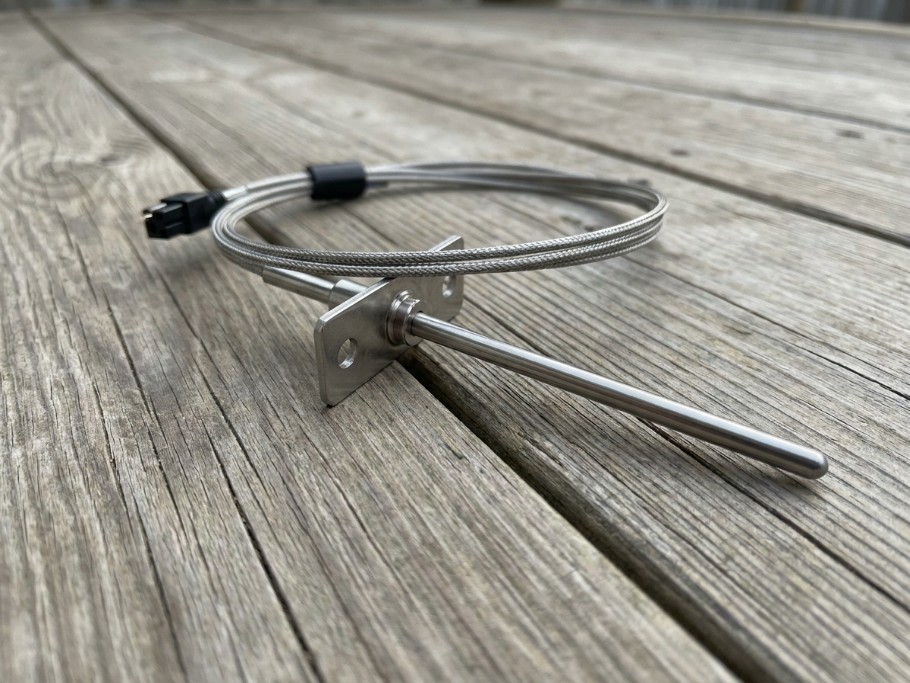
If the free checks above don't clear an ErL or Er1 code, a replacement RTD temperature probe is the most commonly reported next step, and it's a part you can swap yourself.

Confirm the listing matches your exact model before ordering. Pit Boss sells more than one probe shape across its lineup, and a replacement built for the wrong model won't fit. It's a cheap part relative to a service call, which is part of why swapping the probe is worth trying before you assume something bigger has failed.
Frequently Asked Questions
My Pit Boss showed a code for a second, then it went away. Is that a problem?
Is there one master list of Pit Boss error codes for every model?
Should I replace the temperature probe the first time I see ErL or ErH?
What Works
- A genuine RTD temperature sensor replacement built for one specific Pit Boss part number (PB1000XL-025-R00 V2)
Watch Out For
- Only replaces the temperature probe circuit. If an ErH code's real cause is the fan motor or the controller instead, swapping this part alone won't fix it