
The hopper has pellets. The power is on. A restart and a longer wait haven't fixed it either.
If none of that resolved it, the fix depends on which symptom you're actually seeing. Our pellet grill guide covers why a support library organized around the wrong axis is a pattern that shows up across brands. recteq's own documentation is a clean example of it.
"recteq not heating up" isn't one problem.
It's the umbrella most owners reach for to describe at least five genuinely different symptoms. recteq's own support library spreads the fixes for them across six separate, largely un-cross-referenced official articles.
Search that exact phrase and recteq's own support site is nearly the whole result set. Six of the top results in our research were support.recteq.com's own troubleshooting articles.
The only outside page we found was an aftermarket parts seller's blog, not an editorial guide, and it didn't organize the six symptoms either. Nobody has built the triage step that tells you which of the six actually applies to what you're seeing.

Start Here: Is There an Error Code on the Screen?
That single question splits the whole problem in half.
If yes, you're looking at ER-2 (or possibly ER-3, covered below so you don't confuse the two). recteq's own documentation is specific here.
An ER-2 means the grill failed to reach 180 degrees within 30 minutes. The cause it names first is an auger jam or pellet bridge, fuel that isn't making it to the fire.
If there's no code at all, an auger jam isn't your problem. The real question becomes which of four no-code symptoms you're actually seeing.
No Code, Slow to Start
If the grill is new, or you're new to pellet grilling, a longer heat-up time isn't a fault. recteq's own documentation frames this directly as an adjustment period.
A pellet grill has to start, nurture, and precisely control a live wood fire. That process takes longer than an instant-ignition fuel type does.
We wouldn't touch a single screw for this one. If the grill is otherwise firing up and eventually holding temperature, slow just means slow, and patience is the whole fix.
No Code, Temperature Swinging Mid-Cook
If your temperature reading is climbing and falling with no clear pattern, check your own habits first. recteq's own named cause here is behavioral, not mechanical: lifting the lid to let heat out when the grill runs a little hot tricks the controller into thinking it's already cooled down.
That does more harm than good. Leave it alone instead, and let the controller do its job.
Separately, recteq names pellet age as its own cause. If your pellets are older than six months, clear the hopper and load a fresh bag. Low-quality or old pellets can produce abnormal temperature behavior on their own, independent of anything mechanical.
Of the five symptoms in this article, we'd rank this the most avoidable, since the fix is a habit change and a fresh bag, not a part.
No Code, One Area Running Hot or Cold
If one side of the grate sears fine while the other barely browns, that's a different symptom than anything above. The controller can read correctly while part of the grates still runs hotter or cooler than the rest.
recteq's own firepot is center-mounted specifically to spread heat evenly across the cooking surface, so this shouldn't normally happen at all.
When it does happen anyway, recteq names airflow as the single biggest cause. Its own documentation calls out the two-smokestack BFG model by name as one to watch for ventilation imbalance.
After that, check that the drip pan and heat deflector are actually seated correctly. Improper placement of either one throws off heat distribution on its own, no airflow problem required.
And some unevenness is just geometry: the two voids at the front and back of the cooking chamber run cooler than the center by design, not by defect.
This is the one symptom on this page we'd actually crack the lid open to check, since it changes where you place food on the grate, not just how you read the dial.
No Code, Controller Reads Fine But Your Probe Disagrees
If you've clipped on your own thermometer and it disagrees with the controller, don't panic. This isn't a fault at all. recteq's own guidance is to trust the Actual Temp on the controller screen over a third-party probe, since the two readings will never match exactly.
The reason is a matched-system argument, not a dismissal. recteq calibrates its RTD sensors and PID controllers together, specifically so the controller's own reading is the accurate one for that specific grill.
We'd stop chasing this one entirely. A disagreement here isn't really a symptom. It's two different instruments measuring two different things, and only one of them was built for this exact grill.
A Different Code Entirely: ER-3
If your screen shows ER-3 instead, don't use this page to diagnose it. That code isn't the failure-to-light code above.
recteq's own documentation ties ER-3 to either a grease fire or an RTD connection issue. That's a different condition, with a different fix path than anything above. Our recteq error codes guide covers ER-1 and ER-3 in full, including which of ER-3's two causes is actually the more common one.
If the Igniter Itself Has Failed
Unplug and let the grill cool before doing anything below.
recteq's own Igniter Rod Troubleshooting documentation has one instruction worth knowing, even if the rod looks physically fine. Remove the interior components, and clean the fire pot of pellets and ash. Ash buildup around a rod that looks intact can still keep it from lighting the pellets.
If the rod has genuinely gone out, recteq's own documentation confirms the cook isn't over. You can light the fire manually. The one rule that comes with it, stated plainly in recteq's own instructions: never use starter liquids like gasoline, kerosene, or lighter fluid.
Not a recteq-Specific Problem
The shape of this issue isn't unique to recteq: a brand's own thorough support library, split across symptom- or generation-specific articles, with nothing routing the reader between them. Traeger's own no-power documentation splits the identical way, just along a different axis.
Traeger organizes by controller generation instead of by symptom type. If you're chasing a fix and it turns out this was really a brand decision all along, our recteq vs Traeger comparison covers where the two actually differ.
Our Pick If the Igniter Turns Out to Be the Cause
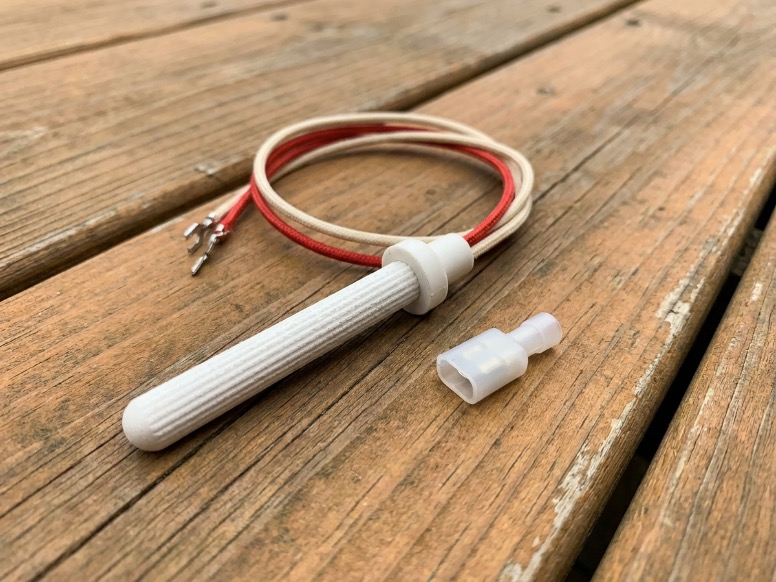
If you've ruled out the free checks above and it really is the igniter rod, here's a compatible ceramic replacement built for the models this article covers.

One thing to check before you order: this style of part won't fit a recteq built before March 2017, since older units run a different ignition system. If your grill is newer than that, it's compatible with the RT-590 and RT-700. RT-700 is now discontinued, succeeded by recteq's current Flagship 1600.
But once the free checks above are exhausted, and a cold, ash-free fire pot still won't light, swapping the rod is the next real step. It's a fix, not a guess.
Frequently Asked Questions
My recteq shows ER-2. Is that the same as it just not heating up?
Is a slow heat-up on a brand-new recteq something to worry about?
How do I know it's the igniter and not something else?
What Works
- Compatible with the RT-590 and RT-700 (RT-700 is discontinued, succeeded by the current Flagship 1600)
Watch Out For
- Won't fit a recteq built before March 2017, since older units use a different ignition system than the Hotflash Ceramic system this part replaces